A leather bag can look convincing in a shop window, yet feel very different once you handle it. The grain, edges, lining, and hardware each offer useful clues about its materials and construction. Still, no single detail proves that a bag is genuine. Natural leather varies, and skilled finishing can make different materials look surprisingly alike. Look closely, and take your time.
This guide explains How to tell if a leather bag is genuine or fake through seven practical checks. You’ll learn what to notice in the surface texture, smell, seams, cut edges, labels, and overall feel. For example, gently flex a discreet area and watch how the surface responds; avoid scraping or damaging a bag just to test it. Check product descriptions and seller information, too, since tactile clues can be misleading. A strong chemical odor or perfectly repeated grain may raise questions, but neither is conclusive on its own. Even experienced buyers can misjudge a polished finish. That is worth remembering.
The aim is not to promise a foolproof test. It is to help you compare several clues, ask better questions, and make a more informed choice. If details conflict, request clearer material information or seek an independent assessment before buying.
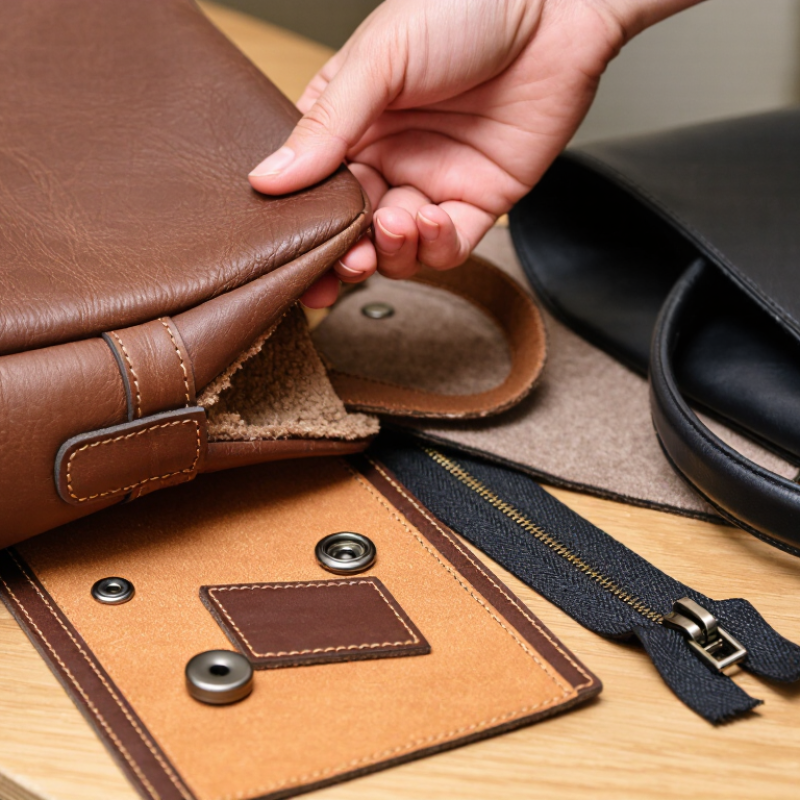
A product label is your first clue, not a verdict. Look for the animal type and the specific leather construction: full-grain, corrected-grain, or split leather. “Genuine leather” confirms a leather material, but alone it does not tell you the hide layer, finish, or durability. “Bonded leather” usually describes leather fibres combined with a binder, rather than one continuous hide. Details matter. Check whether the label names coatings or mixed materials, too. A thin plastic layer can change the surface feel and appearance.
Compare the label with the bag itself. Inspect an unfinished edge near a pocket or strap: real hide may show irregular fibres, while a uniform, fabric-like backing can suggest a composite. Look closely. Grain should vary naturally, though embossing can imitate those markings. The ISO 17131:2012 leather-identification standard describes microscopic examination as a way to distinguish leather from non-leather materials; a visual check is less conclusive. If the label is vague, ask the seller for the leather type and written material specification. Keep the answer with your receipt. I have found that even careful shoppers can mistake a convincing finish for proof. It is a useful check, not certainty.
Hold the bag near a window and examine the surface in soft, even light. Genuine leather often shows small differences in pore size, shape, and spacing. Look across the center panel, corners, and areas near the seams. Natural grain rarely repeats like a printed pattern. Small irregularities matter.
Check several sections, not just one attractive patch. A flap may look varied while the side panels show an identical texture. Compare the grain on both sides, and notice whether marks flow naturally around folds and curves. Still, surface treatments can smooth or emboss real leather, so a uniform finish alone does not prove a bag is synthetic. Some genuine hides look quite consistent.
Run your fingertips lightly over the surface. Natural grain may feel subtly uneven, though softness varies with the leather’s finish and construction. A perfectly repeated pattern across large areas deserves a closer look. Not proof. Treat grain as one clue, then consider the smell, edges, stitching, and product information together. I’ve found that lighting can exaggerate tiny marks, so check again from another angle before judging.
Hold the bag in your hands and notice its surface. Genuine leather often feels warm and slightly varied, with fine grain changes rather than a perfectly repeated pattern. Run a fingertip across it: the texture may feel smooth in one spot and subtly pebbled nearby. But finish matters. Heavy coatings can make real leather feel slick, while some imitation materials are made to feel convincing. Notice the recovery. Gently press an inconspicuous area; leather may yield a little, then ease back without feeling papery or rigid. Avoid pinching hard or making a sharp crease, since that can mark either material.
Flexibility offers another clue. Lift a strap and bend it naturally near a seam. Leather usually moves with a supple, connected feel, and small wrinkles may form where it bends. A stiff bag is not automatically fake; thick leather, lining, age, and storage can all affect movement. Smell the interior and an unfinished edge, if one is easy to reach. Real leather often has a mild, earthy scent, while plastic-like or strongly chemical odors may suggest synthetic materials or coatings. Smell alone is weak. I have found that expectations can mislead: leather treatments vary, and a new bag may smell faintly of finish. Use feel, flex, and scent together, and treat them as clues, not proof.
Turn the bag over and study the cut edges. Genuine leather often shows dense, irregular fibers along an unfinished edge, while coated or synthetic material may look smooth, layered, or fabric-backed. But edge paint can hide the material, and some leather edges are carefully sealed. So, one clue is not proof.
Check the seams where straps meet the body and around corners. Stitches should follow a steady line, with similar spacing and no loose loops, skipped holes, or fraying thread. Gently flex the bag near a seam; puckering or a sharp ridge can suggest uneven tension or weak reinforcement. The ISO 11640:2012 leather test standard measures color fastness through controlled, repeated rubbing. It is a lab method, not a home authenticity test, but it reinforces an important point: surface appearance alone cannot establish material quality.
Look inside pockets and under the flap, where construction is easier to inspect. A cleanly finished lining, reinforced handles, and neatly folded edge turns suggest careful workmanship, though they do not prove the bag is leather. I have seen neat stitching on imitation material, too. Smell, softness, and price can mislead; compare several details, and ask for material documentation when the claim matters. A little uncertainty is sensible.
A bag’s price is a clue, not proof of its material. Compare it with the product description and the maker’s available information. A very low price may deserve closer checking, especially if the listing claims premium leather and careful construction. Still, discounts, size, and simpler designs can explain lower prices. Price alone cannot confirm authenticity.
Check whether the material description is specific and consistent across the listing, care instructions, and product tag. Terms such as full-grain or top-grain describe particular leather types, while “genuine leather” can be broad. Look closely at photos of edges, seams, and the reverse side, if shown. Natural variation may appear, but neat stitching and a clear material breakdown offer more useful clues than polished product photos. I would not rely on smell or touch alone; both can mislead.
Tip: Compare like with like. Check the stated leather type, bag size, hardware, and included care details against the price. Read the maker’s material and return information, too. If details conflict or remain vague, ask for clarification before buying. One detail may be imperfect; consider the whole picture.
| Tip | What to Check | Clues Consistent with Leather | Warning Signs and Limitations | Price and Seller Information |
|---|---|---|---|---|
| 1 | Read the material label and product description. | Look for a clear statement that the relevant parts are leather, and check whether it specifies the material used for the body, trim, lining, and straps. | Terms such as “leather-look,” “vegan leather,” or “PU” generally describe non-animal materials. “Genuine leather” indicates leather but does not, by itself, establish a particular grade or level of quality. | Compare the listed materials with the item’s price and the seller’s written description. A vague or contradictory description deserves clarification before purchase. |
| 2 | Examine the grain and surface under good light. | Natural leather often has small variations in pores, grain, or texture. These differences may be subtle, especially on corrected or coated leather. | A perfectly uniform surface can be a sign of an artificial material, but an even finish does not prove that a bag is synthetic. Embossing and coatings can also alter the appearance of real leather. | Do not treat a high price or a “premium” description as proof of natural grain. Compare the surface with the material details in the listing. |
| 3 | Inspect cut edges and hidden areas. | Where visible, leather edges may show a fibrous or layered structure. Unfinished areas inside a pocket or beneath a flap can offer more information than the polished outer surface. | Painted, folded, or sealed edges can conceal the underlying material. Synthetic materials may also have a fabric backing, so one edge alone is not conclusive. | Check several areas rather than relying on a single close-up. Ask the seller for clear photos of interior seams or an exposed edge if these details are missing. |
| 4 | Feel the material gently and notice how it bends. | Leather often feels flexible and may develop soft creases when gently pressed. Its feel varies with tanning, thickness, finish, and construction. | Stiffness does not automatically mean imitation material: thick, structured, or heavily finished leather can feel firm. Softness alone is not proof either. | Compare the feel with the bag’s stated construction and intended use. Consider whether the price seems consistent with the materials and workmanship described. |
| 5 | Look closely at stitching, seams, and lining. | Consistent stitching, reinforced stress points, and neatly finished seams can indicate careful construction. These features help assess craftsmanship, not material composition by themselves. | Good stitching can be used on synthetic bags, while genuine leather bags can have imperfect finishing. A leather exterior may also be combined with synthetic trim or lining. | Check whether the price and product description account for mixed materials. Confirm which parts are leather instead of assuming the entire bag is made from it. |
| 6 | Check the weight and structure in context. | Leather can feel substantial, but weight depends on hide thickness, hardware, lining, and bag design. A well-made leather bag may be lightweight or structured. | Weight is not a reliable standalone test. Heavy hardware or a thick lining can make a synthetic bag feel substantial, while lightweight leather is also possible. | Compare weight with the listed dimensions, materials, and construction rather than using a fixed price or weight threshold. |
| 7 | Verify seller details, documentation, and price claims. | Specific material descriptions, consistent product photos, a clear return policy, and traceable purchase documentation make a listing easier to assess. | A brand name, logo, certificate image, or unusually low price does not independently prove authenticity. Avoid relying on a single claim or a so-called water or burn test, which can damage the bag. | Compare the price with similar bags of comparable size, construction, and stated materials. Treat a large unexplained discount as a reason to verify details, not as proof of a fake. |
Note: Appearance and touch can provide clues but cannot conclusively identify every leather type. For a valuable purchase, seek a written material disclosure and use a qualified leather professional if verification is important.
Look for the animal type and construction, such as full-grain, corrected-grain, or split leather. “Genuine leather” is broad. It confirms leather, but not quality or durability.
Usually not. It often contains leather fibres combined with a binder. The surface may also include a coating or mixed material.
Inspect an edge near a pocket or strap. Real hide may show uneven fibres. A smooth, fabric-like backing can suggest a composite material.
No. Natural grain usually varies, but embossing can imitate it. Visual inspection helps, yet it is not conclusive.
It often feels warm, slightly varied, and flexible. One area may feel smooth, while another feels subtly pebbled. Heavy coatings can make real leather feel slick.
Bend a strap gently near a seam. Leather may form small wrinkles and recover gradually. Do not pinch hard or make sharp creases.
No. Real leather may have a mild, earthy scent. Strong chemical or plastic-like smells can suggest coatings or synthetic materials. Smell is only a clue.
No. Discounts, small size, and simple designs can lower the price. Still, an unusually low price deserves closer checking.
Compare the stated leather type, bag size, stitching, hardware, care details, and return information. Conflicting descriptions deserve questions before buying.
Ask the seller for a written material specification. Keep it with your receipt. This is sensible, but mistakes can still happen.
Knowing How to tell if a leather bag is genuine or fake starts with checking the product label and identifying the leather type it claims to use. Look closely at the surface: real leather often has subtle, irregular variations in its grain, while an overly uniform pattern may suggest a manufactured finish. You can also assess the material by touch and smell. Genuine leather usually feels supple and develops a natural warmth in your hand, rather than feeling consistently plastic-like.
Next, inspect the bag’s edges, stitching, and overall construction. Neat, secure seams and carefully finished edges can indicate thoughtful workmanship, though they do not prove the material’s authenticity on their own. Finally, compare the stated material and construction details with the bag’s price and available product information. Considering these clues together gives you a more reliable assessment than relying on any single test, and helps you make a more informed purchase.

Minyan Bag